Today, I’m going to explain why off-page SEO is essential for improving your website’s position on search engines. Many people focus only on on-page SEO and ignore off-page factors, but without strong off-page signals, ranking becomes very difficult.
There are many terms related to off-page SEO, and I will explain them clearly. More importantly, I will guide you on what healthy and organic off-page SEO really means — the kind that builds long-term authority and sustainable rankings.
With 8 years of experience in digital marketing, I’ve learned many of these lessons through struggle and real-world testing. What I’m sharing today comes from practical experience, not theory.
So let’s start and understand what off-page SEO is, why it matters, and how it directly impacts your website ranking.
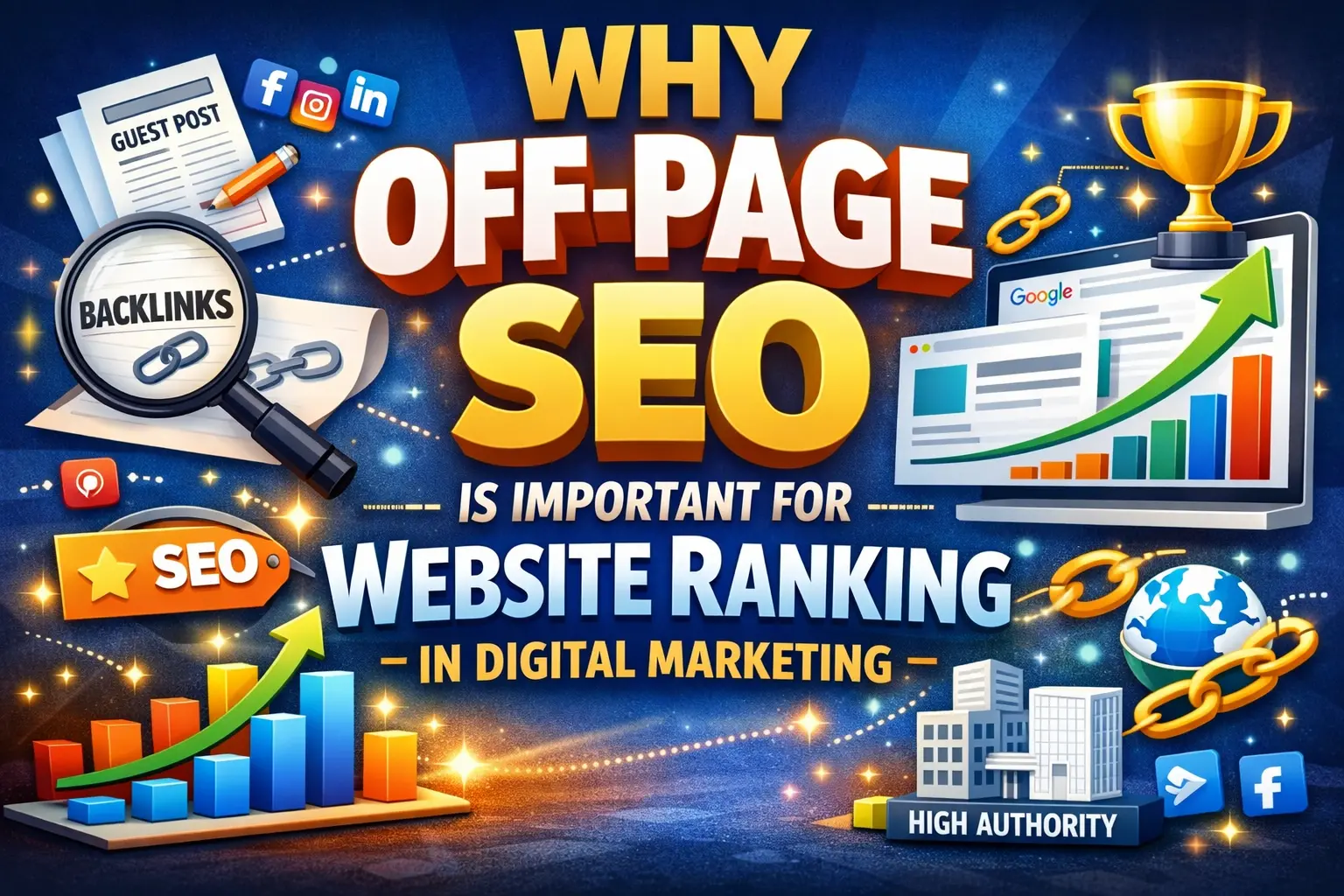
Why Off-Page SEO Is Important for Website Ranking in Digital Marketing
You already understand the introduction. Now let’s go deep and clearly explain everything in a practical way.
Off-page SEO is known by many names — backlinks, guest posting, link building, authority building, referral links, domain signals — but all of these are parts of the same strategy.
When you publish a website in a niche, remember one thing:
Google already has thousands of websites showing the same information.
So when you enter as a new website, why would Google give you priority?
It won’t.
Not because your content is bad — but because you have no authority yet.
And in digital marketing, authority is everything.
What Is Off-Page SEO?
Off-page SEO includes all activities you do outside your website to improve your ranking in search engines.
It is mainly about:
-
Building quality backlinks
-
Getting mentions from other websites
-
Guest posting
-
Social media sharing
-
Brand signals
-
Increasing referring domains
In simple words:
Off-page SEO tells Google how the internet sees your website.
If high-authority websites link to you, Google assumes your website is valuable.
If no one links to you, Google assumes you are not important yet.
Why Google Prioritizes Authority
Google trusts authority.
Yes, Google also values:
-
Good content
-
Proper on-page SEO
-
Technical SEO
But permanent ranking is very difficult without off-page SEO.
You can rank temporarily with strong on-page SEO.
But to stay permanently on page one, you need backlinks and authority signals.
Imagine two websites:
Website A:
-
Good content
-
No backlinks
Website B:
-
Good content
-
50 high-quality backlinks from relevant sites
Which one will Google rank higher?
Website B.
Why?
Because authority + relevance wins.
The Real Example From Experience
Let me explain something practical.
I built many websites just for testing.
I found good niches.
I wrote strong content.
I optimized on-page SEO properly.
But I did not do off-page SEO.
No guest posts.
No backlinks.
Result?
They did not rank.
Then I created new websites and focused strongly on off-page SEO:
-
Relevant guest posts
-
High-quality backlinks
-
Slow and natural link building
-
Social media presence
Those websites ranked much better.
This does not mean you should create 100 backlinks in one day.
That is called spamming.
If you attach your website to 100 random websites in a week, Google can penalize you. Updates can hit your website, and your rankings can disappear.
Off-page SEO must be natural.
What Is Healthy and Organic Off-Page SEO?
Healthy off-page SEO means:
-
Building backlinks slowly
-
Choosing relevant websites
-
Getting links from real traffic sites
-
Avoiding spam directories
-
Avoiding paid link farms
For example:
Instead of creating 50 backlinks in one week, build:
-
1 strong backlink per week
-
From a relevant niche website
-
With natural anchor text
This looks organic.
Google likes natural growth.
Types of Off-Page SEO Techniques
1. Guest Posting
Guest posting means writing an article on another website and placing your website link inside it.
But remember:
-
Website must be relevant
-
Website must have authority
-
Content must be valuable
Bad guest posting = spam
Smart guest posting = authority building
2. Backlinks (DoFollow vs NoFollow)
There are two types of backlinks:
DoFollow Links
These pass authority to your website.
They help improve rankings.
NoFollow Links
They do not pass direct authority but still bring traffic and natural profile balance.
Many people say only DoFollow matters.
Not true.
You need a natural mix of both.
If your profile is 100% DoFollow, Google may consider it unnatural.
3. Social Media Signals
Create pages on:
-
Facebook
-
LinkedIn
-
Instagram
-
X (Twitter)
Share your articles regularly.
Even though most social media links are NoFollow, they:
-
Increase traffic
-
Build brand awareness
-
Create trust signals
Google notices brand searches and engagement.
4. Referring Domains
Google does not just count backlinks.
It counts referring domains.
10 backlinks from 10 different websites are stronger than 50 backlinks from 1 website.
Diversity matters.
5. Brand Mentions
Even if someone mentions your brand without linking, it still builds authority.
Brand awareness improves ranking indirectly.
Benefits of Off-Page SEO
1. Higher Search Engine Rankings
With strong authority signals, Google pushes your site higher for competitive keywords.
Especially in difficult niches, off-page SEO becomes the deciding factor.
2. More Organic Traffic
When ranking improves:
-
Clicks increase
-
Visitors increase
-
Leads increase
Traffic becomes stable and long-term.
3. Better Domain Authority
As you build backlinks from relevant websites, your domain authority improves.
This helps future content rank faster.
4. Increased Website Exposure
When your website is mentioned across platforms:
-
More people discover you
-
More users trust you
-
More brands collaborate with you
5. Long-Term Stability
Websites with strong backlink profiles survive Google updates better.
Weak websites disappear after updates.
Common Off-Page SEO Mistakes
Let’s talk about serious mistakes people make.
Mistake 1: Creating 100 Backlinks in One Day
This is spam.
Google’s algorithm is smart.
Unnatural link velocity triggers penalties.
Mistake 2: Buying Cheap Backlinks
Fiverr backlinks.
PBN (Private Blog Network) links.
Spam directory links.
These can destroy your website.
Mistake 3: Irrelevant Backlinks
If your niche is digital marketing and you get backlinks from a cooking blog — it looks suspicious.
Relevance is very important.
Mistake 4: Only Focusing on DoFollow
A natural profile includes:
-
DoFollow
-
NoFollow
-
Social links
-
Brand mentions
Balance matters.
Mistake 5: Ignoring Anchor Text Strategy
If every backlink uses the same keyword, Google sees manipulation.
Use:
-
Branded anchors
-
Naked URLs
-
Generic anchors
-
Partial match keywords
Ranking After Success – What People Forget
Many websites rank and then stop working on off-page SEO.
Big mistake.
If competitors continue building authority and you stop, they will overtake you.
SEO is ongoing.
You must:
-
Keep building links slowly
-
Keep creating content
-
Keep strengthening authority
Ranking is not permanent without maintenance.
Pros and Cons of Off-Page SEO
Pros
-
Improves authority
-
Increases rankings
-
Builds brand trust
-
Brings referral traffic
-
Helps long-term SEO stability
Cons
-
Takes time
-
Requires effort
-
Needs patience
-
Wrong strategy can cause penalties
But the benefits are much bigger than the risks — if done correctly.
The Final Truth About Off-Page SEO
On-page SEO makes your website optimized.
Off-page SEO makes your website trusted.
Without trust, Google will not rank you long-term.
You can have the best content in the world — but if no one links to you, Google does not see you as important.
Authority wins.
But remember:
-
No spamming
-
No shortcuts
-
No bulk link building
-
Focus on quality
-
Stay consistent
Build 1 strong backlink per week instead of 50 weak ones.
Think long-term.
That is real, organic, healthy off-page SEO.
And that is how you rank permanently in digital marketing.